So, you’re ready to sell your rental property. The local housing market is peaking, you’ve forced some serious appreciation through renovations, and the cash profit looks incredible. But then you realize the tax bill will wipe out a massive chunk of that gain. That is exactly why property investors partner with 1031 exchange companies. These specialized firms serve as the Qualified Intermediary (QI) required by the IRS to execute a tax-deferred exchange, allowing you to rollover 100% of your sale proceeds into a new investment property.
Leaving capital gains taxes unpaid is not an option. If you pocket the proceeds directly, the IRS will tax your gain at rates up to 20%, plus state taxes and depreciation recapture. For a property with $200,000 in equity growth, you could easily write a check for $60,000 to the government. Using Section 1031 of the internal revenue code lets you defer that tax entirely, keeping your capital fully active and working for you.
In this guide, we will break down the mechanics of the 1031 process, why the IRS requires a Qualified Intermediary, and how to select a secure partner to safeguard your capital during the property transition. Let's make sure your hard-earned real estate equity stays exactly where it belongs—in your portfolio.
Why the IRS Mandates the Use of 1031 Exchange Companies
First, let's explore why IRS rules mandate using 1031 exchange companies. The core concept of a Section 1031 exchange is that you are exchanging one property for another "like-kind" property. In the eyes of the tax code, you never actually realized a capital gain because your investment remains continuously active within real estate. However, to maintain this legal status, you must never gain access to the sale proceeds.
Under Section 1031 of the tax code, you cannot touch the sale proceeds yourself. If you do, it triggers an immediate tax event. Qualified 1031 exchange companies hold the funds in a secure escrow account during the transaction. This prevents "constructive receipt" of the money. If the sales proceeds touch your personal bank account even for a single second, the exchange is voided, and your entire tax deferral is disallowed by the IRS.
The intermediary acts as an independent facilitator. They draft the exchange agreement, prepare the necessary tax disclosures, and instruct the title company on where to wire the funds upon closing. This independent structure is what preserves the tax-deferred status of your transaction.
How to Vet Intermediaries: Vetting for Safety
Choosing reputable 1031 exchange companies is the most critical step in a successful property transition. Because the Qualified Intermediary holds your entire sale proceeds in escrow for weeks or months, you are essentially trusting them with your entire business capital. If they mismanage the funds, go bankrupt, or commit fraud, your money could disappear, and you would still owe the IRS the capital gains tax.
Not all 1031 exchange companies are created equal, and the industry is surprisingly unregulated. There are no federal licensing requirements for Qualified Intermediaries. Anyone can set up a website and claim to facilitate exchanges. Therefore, you must perform strict due diligence before selecting a partner.
When interviewing potential 1031 exchange companies, check their fidelity bond coverage and financial history. You want a firm that carries a fidelity bond of at least $10 million to protect against employee theft or fraud. Additionally, verify that they hold exchange funds in segregated, interest-bearing escrow accounts (using a qualified escrow or trust structure) rather than commingling your money with their corporate accounts.
Top-tier 1031 exchange companies carry significant errors and omissions (E&O) insurance to protect your capital. This insurance covers administrative mistakes, such as missing IRS deadlines or drafting incorrect documentation, which could invalidate your tax deferral. Ask for proof of insurance and verify their coverage limits before signing a contract.
The best 1031 exchange companies will assign a dedicated exchange officer to guide you through the strict timelines. You want a team that responds immediately to emails and phone calls. Commercial and residential property closings are fast-paced, and any delays in wire transfers or document signatures can jeopardize your exchange.
Navigating the Strict 1031 Deadlines
The IRS is completely unforgiving when it comes to exchange deadlines. If you miss a deadline by even a single minute, your exchange fails, and there are absolutely no extensions (except in rare cases of federally declared natural disasters). Your intermediary is responsible for tracking these dates, but you must understand them as well.
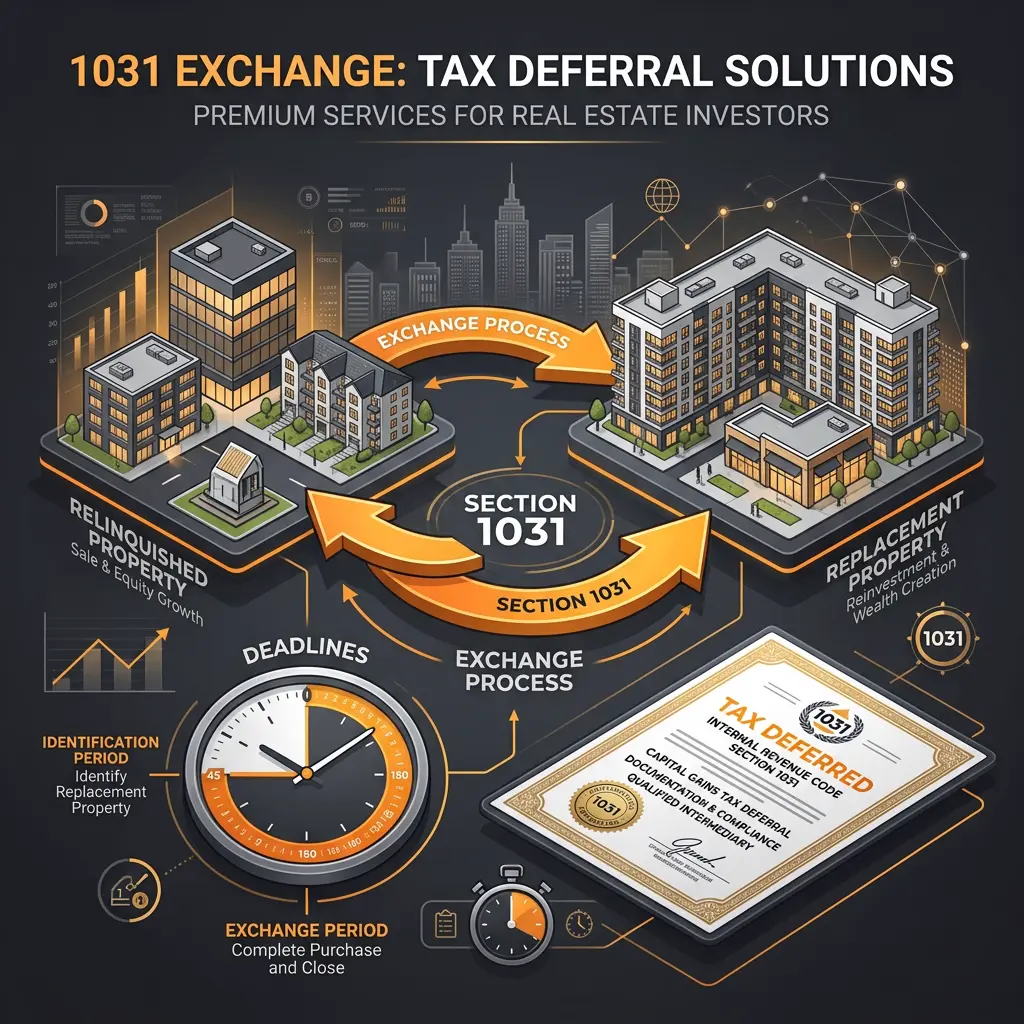
Once you close the sale of your old property, your 1031 exchange companies will start the 45-day clock. You have exactly 45 calendar days from the date of closing to identify your replacement properties in writing. This identification must follow strict IRS guidelines, such as the Three-Property Rule or the 200% Rule, which limit the number and value of properties you can target.
You must submit the written identification of replacement properties to your 1031 exchange companies before the 45th day. The document must contain unambiguous descriptions of the target properties, such as physical street addresses or legal descriptions, signed by all partners in the exchange entity.
After the identification phase, your 1031 exchange companies will coordinate the purchase of the new property within 180 days. This 180-day window runs concurrently with the 45-day window, meaning you have a total of 180 days from the initial sale to close on the replacement property. Your intermediary will wire the escrow funds directly to the closing agent to finalize the purchase. For a detailed breakdown of these rules, Investopedia's 1031 exchange resources offer an excellent, comprehensive guide.
Using experienced 1031 exchange companies ensures you do not run afoul of complex IRS rules during title transfer. The tax code requires that the taxpayer selling the old property must be the exact same taxpayer buying the new property. If you sell under a personal name, you cannot buy under a newly formed LLC without violating the "same taxpayer" rule, unless the LLC is structured as a disregarded entity. Your exchange officer will review your corporate deeds to ensure compliance.
For more research on Section 1031 transactions, the public legal databases at the National Association of Realtors (NAR) compile historic court cases and IRS rulings to help investors avoid common traps.
Frequently Asked Questions
Q: Can I use my local real estate attorney or CPA as my Qualified Intermediary?
A: No. IRS regulations explicitly state that your QI must be an independent, unrelated party. Anyone who has acted as your employee, attorney, accountant, or real estate broker within the past two years is considered a "disqualified person" and cannot facilitate your exchange. You must hire an independent third-party firm.
Q: What is "boot" in a 1031 exchange?
A: Boot represents any non-like-kind property or cash you receive during the exchange. If you sell a property for $500,000 but only purchase a replacement property for $450,000, the remaining $50,000 is considered cash boot and is subject to capital gains taxes. Similarly, if your mortgage debt decreases on the new property, that reduction is treated as mortgage boot and is also taxable.
Q: Can I perform an exchange on my primary residence?
A: No. Section 1031 exchanges are strictly limited to properties held for productive use in a trade or business, or for investment. Your primary home does not qualify. However, primary residences are subject to their own tax exclusion rules under Section 121, which allows individuals to exclude up to $250,000 (or $500,000 for married couples) of capital gains if eligibility criteria are met.
Q: How much do 1031 exchange companies charge for their services?
A: Most reputable intermediaries charge a flat fee for a standard delayed exchange. This fee typically ranges between $800 and $1,500, which covers the sale of one property and the purchase of another. More complex structures, such as reverse exchanges (where you buy the new property before selling the old one) or construction exchanges, carry significantly higher fees.
Q: What happens to my deferred taxes when I eventually sell the replacement property?
A: The taxes remain deferred until a future taxable sale occurs. However, many investors utilize a strategy known as "swap till you drop." They continuously defer capital gains taxes through multiple exchanges throughout their lifetime. Upon their death, their heirs receive the properties with a "stepped-up basis" to current market value, effectively erasing the deferred tax liability entirely.
Conclusion
In conclusion, partnering with compliant 1031 exchange companies is essential to protect your real estate equity. By selecting a Qualified Intermediary with strong fidelity bonds, segregated escrow accounts, and deep regulatory expertise, you can confidently navigate the strict 45-day and 180-day IRS deadlines. Take the time to interview several providers, review their credentials, and safeguard the capital you've worked so hard to build. Start planning your property transition early to maximize your tax savings.